
Where History Does Not Speak Aloud — Nearly 4,000 Years Ago
Bihar is remembered as the land of awakening—of Buddha beneath the Bodhi tree (c. 563 BCE), of Mahavira’s renunciation (c. 599 BCE), of Sita’s sacred birth (legendary period, c. 5000 years ago). Yet beneath these luminous chapters lies another layer of memory, older and almost forgotten, where Krishna and Radha exist not in towering temples, but in hills, battlefields, ancient rivalries, place‑names, and living folk songs.
Bihar does not proclaim Krishna and Radha. It allows them to pass through time—silently.
Krishna’s Birth and the Two Homes That Shaped Destiny — c. 3228 BCE
Parents of Lord Krishna
- Biological Father: Vasudeva
- Biological Mother: Devaki
- Foster Father: Nand Baba
- Foster Mother: Yashoda Maiya (Gokul–Vrindavan)
Krishna was born in chains, inside Kansa’s prison, around 4,000 years ago, when Mathura and Magadha were emerging as strong rival kingdoms. Devaki gave birth under prophecy and fear, while Vasudeva carried the newborn across storm and river.
Yet it was in the humble home of Yashoda Maiya and Nand Baba that Krishna learned laughter, mischief, and love.
Devaki gave him life; Yashoda gave him the world.
When Krishna escaped Mathura’s prison and grew beneath Yashoda’s watchful eyes, the echo of that escape reached Magadha, ruled by Jarasandha—one of the strongest kings of his time.
Magadha — Where Krishna Became a Strategist — c. 3220–3200 BCE
Jarasandha of Girivraj (Rajgir)
Long before Rajgir became a Buddhist center, it was Girivraj, the iron capital of Magadha. Its king, Jarasandha, stood shoulder to shoulder with rulers of Mathura, Hastinapura, and Indraprastha.
Krishna had slain Kansa, Jarasandha’s son-in-law, igniting a shadow war:
- Jarasandha attacked Mathura seventeen times
- Krishna strategically withdrew to preserve life and future
- He earned the title Ranchhod, misunderstood as retreat
In Magadha, Krishna did not lift a flute—he lifted the future with strategy.
The stones of Jarasandha Akhara in Rajgir still witness an era nearly 4,000 years old.
Gopalganj — When a Name Becomes Memory — c. 3200 BCE
No grand shrines mark this land. Yet the memory survives in a single word—Gopal. Local traditions speak of ancient cattle routes used by Yadava clans after the Mahabharata war, connecting eastern Bihar with Krishna’s early life.
When temples vanish, names endure.
Chirand of Saran — Where Time Refuses to Forget — 4000–3500 Years Ago
Chirand, near modern Chhapra, is among the oldest living settlements of the subcontinent. Its soil holds stories from the same era as the late Dvapara Yuga and the early Mahabharata period.
Oral traditions whisper of Yadava presence, placing Krishna’s influence closer to Bihar than commonly recorded.
When written history falls silent, the earth itself begins to speak.
Radha Rani — The Presence Without a Place — c. 3220 BCE
Radha’s Parents, Briefly Remembered
- Father: Vrishabhanu
- Mother: Kirti (Kirtida)
Radha’s lineage is mentioned in tradition but does not define her essence. She became eternal through devotion.
Radha had parents, but devotion remembers her as eternal.
Mithila — Where Radha Became Philosophy — c. 3200 BCE
In Bihar’s Mithila, Radha is preserved in folk songs, not idols. Known as Radha Sakhi, she symbolizes prem tattva—love as divine consciousness.
Mithila did not ask where Radha was born. It asked what love truly means.
Krishna’s Family and the Eastern Memory — c. 3220 BCE
Krishna belonged to the Yadava dynasty. Over centuries, oral memory spread eastward:
- Balarama, elder brother, symbol of agriculture and strength
- Subhadra, sister, central to devotional traditions in eastern India
Eastern India did not archive Krishna’s family—it absorbed them into culture.
Why Bihar Kept These Stories Quiet
Bihar chose restraint over display:
- The land centered on Buddha (563 BCE), Mahavira (599 BCE), and Sita (5000 years ago)
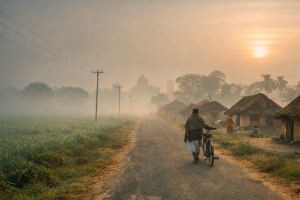
- Krishna and Radha survived in songs, place-names, and village memory
- No monumental temples meant no pilgrimage economy—only remembrance
Some lands build stone monuments. Bihar became a living archive.
Across 4,000 Years
If Vrindavan celebrated Krishna’s love (c. 3220 BCE) and Dwarka proclaimed his rule, Bihar preserved his conflicts, foresight, and Radha’s unseen divinity.
Bihar does not shout the names of Krishna and Radha.
It lets history whisper them—forever.